Description
1. Overview
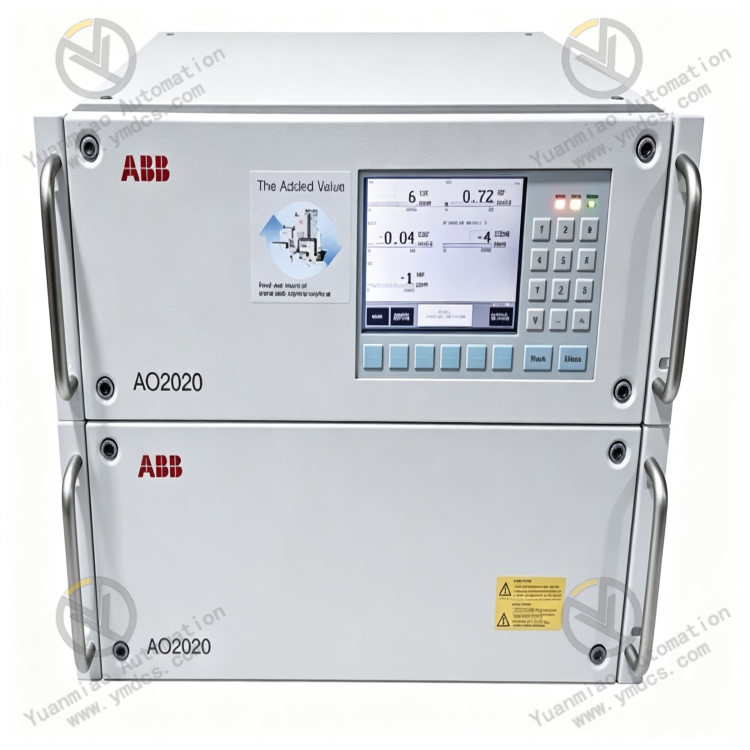
The ABB AO2020‑UVLH‑7673 is an in‑situ / extractive UV online gas analyzer belonging to the ABB AO2000 series. It is a high‑precision analytical instrument dedicated to industrial process gas analysis and environmental flue‑gas emission monitoring. The suffix UVLH‑7673 defines the core detection optical path, range configuration, chassis specification and applicable operating conditions. It serves as a key intelligent analytical device for flue‑gas composition analysis, process gas monitoring and compliance emission monitoring in chemical, thermal power, metallurgical, waste‑to‑energy and building‑material industries.
Adopting the Ultraviolet Differential Optical Absorption Spectroscopy (UV‑DOAS) principle, this analyzer enables continuous online measurement of multiple gas component concentrations without heavy‑consumable conventional sampling pre‑treatment. It features high measurement accuracy, fast response, low drift, strong anti‑interference performance and low operation‑maintenance cost. Complying with national standards for industrial process analysis and environmental monitoring, it supports 7×24‑hour non‑stop operation. It accurately captures variations in process‑gas concentration and flue‑gas emission fluctuations, and covers full‑scenario requirements including closed‑loop process control, environmental‑data uploading and abnormal‑condition early warning. Widely deployed in desulfurization‑denitrification systems, incineration exhaust monitoring, chemical reaction‑gas analysis and kiln flue‑gas online monitoring systems, it is a critical equipment for industrial intelligence, environmental compliance and refined process management.
2. Functions and Features
2.1 Core Functions
Multi‑component high‑precision UV spectral detection: Based on high‑precision UV‑DOAS technology, it continuously measures multiple UV‑active gas components such as SO₂, NO, NO₂ and O₃. Single‑component or multi‑component simultaneous measurement can be configured according to site conditions to meet process monitoring and environmental‑emission‑monitoring requirements, delivering excellent data linearity and repeatability.
Continuous full‑online analytical monitoring: Performs non‑stop real‑time gas sampling and analysis on industrial sites with millisecond‑level data update. It accurately captures instantaneous concentration fluctuations and abnormal emission surges, providing continuous and reliable raw data for process regulation, environmental traceability and fault diagnosis.
Intelligent algorithm compensation for cross‑interference: Built‑in proprietary spectral deconvolution and anti‑interference algorithms automatically eliminate spectral cross‑interference induced by dust, water vapor and co‑existing gases. It effectively prevents data distortion and numerical drift under complex flue‑gas conditions and secures stable measurement accuracy.
Auto‑calibration and zero‑drift correction: Supports scheduled automatic zero‑point calibration, span calibration and temperature‑compensation calibration. It suppresses measurement errors caused by thermal drift, optical‑path attenuation and environmental changes, greatly reducing manual‑calibration frequency and ensuring long‑term measurement stability.
Full‑condition self‑diagnosis and alarm: Comprehensive self‑diagnosis functions continuously monitor UV‑light‑source status, optical‑path loss, sample‑gas flow, temperature, pressure, hardware faults and communication exceptions. Fault points are precisely located and alarm signals are uploaded to support fault tracing and predictive maintenance.
Standard signal output and networking: Supports 4‑20 mA analog output and bidirectional digital‑protocol communication. It seamlessly connects to DCS, PLC, environmental‑data‑acquisition units and host monitoring systems to realize remote data uploading, real‑time display, trend logging and report statistics for intelligent monitoring architectures.
Adaptation to harsh industrial flue‑gas conditions: Optimized for high‑temperature, high‑humidity, high‑dust and corrosive flue‑gas environments. When matched with a proper pre‑treatment system, it runs stably against flue‑gas impurities, temperature swings and on‑site electromagnetic interference for demanding industrial operating conditions.
2.2 Product Characteristics
High‑precision and low‑drift performance: Equipped with long‑life UV light source and high‑resolution spectral sensor. It achieves high measurement accuracy and minimal long‑term drift with excellent full‑range linearity, satisfying stringent requirements for ultra‑low‑emission environmental monitoring and high‑precision process control.
Low‑consumable long‑term‑operation design: Unlike conventional infrared and electrochemical analyzers, the core detection unit requires no frequent consumable replacement. Only routine pre‑treatment‑filter maintenance is needed, lowering O&M cost and downtime for improved overall reliability.
Fast‑response dynamic tracking: Fast spectral deconvolution and low signal‑processing latency enable rapid response to abrupt gas‑concentration changes and accurate tracking of dynamic process variations, suitable for production scenarios with frequent load fluctuations and process adjustments.
Strong industrial anti‑interference capability: Passes rigorous EMC tests with multi‑stage filtering and signal‑shielding structures to suppress electromagnetic disturbances from frequency converters, power cables and industrial equipment, avoiding data jumping and signal anomalies.
Wide‑range temperature adaptive stability: Intelligent temperature‑pressure compensation algorithms adapt to ambient‑temperature and flue‑gas‑condition variations with negligible measurement drift across temperature ranges to guarantee all‑weather measuring accuracy.
Modular maintenance‑friendly architecture: Optical‑path, sampling and signal‑processing units are independently modularized for easy disassembly and clear fault localization. Module replacement shortens equipment‑repair downtime and improves maintenance efficiency.
High‑flexibility expandable configuration: Supports custom measuring ranges, flexible component assignment, configurable alarm thresholds and expandable data storage. Parameters can be adjusted to match industry‑specific conditions, environmental regulations and process requirements for diversified application scenarios.
3. Technical Specifications
| Item | Specification |
|---|---|
| Model | AO2020‑UVLH‑7673 |
| Series | ABB Advance Optima AO2000 Series |
| Equipment Type | UV‑DOAS Online Gas Analyzer |
| Manufacturer | ABB (Switzerland) |
| Detection Principle | Ultraviolet Differential Optical Absorption Spectroscopy (UV‑DOAS) |
| Measurable Components | SO₂, NO, NO₂, O₃ and other UV‑absorbing gases |
| Measurement Accuracy | Full‑scale error ≤ ±0.25 % FS, stable over full temperature range |
| Response Time | Millisecond‑level response, fast data update, strong dynamic‑tracking performance |
| Long‑term Zero Drift | Very low drift; compensated by auto‑calibration for long‑term stability |
| Output Signals | 4‑20 mA analog; standard digital communication interfaces |
| Analog Output Accuracy | Full‑scale error ≤ ±0.3 % FS |
| Operating Ambient Temperature | 15 ℃~35 ℃ (optimal); withstands ‑25 ℃~+65 ℃ |
| Storage & Transport Temperature | ‑25 ℃~+65 ℃ |
| Ambient Humidity | 5 %~95 % RH, non‑condensing |
| Dimension | 483 mm×412 mm×177 mm (standard 19‑inch rack‑mount) |
| Mounting Method | Rack‑embedded cabinet installation |
| Ingress Protection | Cabinet‑grade protection; dust‑proof, moisture‑proof, slight‑corrosion resistance |
| Operational Characteristics | High‑accuracy, low‑drift, fast‑response, anti‑interference, low‑consumable, auto‑calibration, intelligent self‑diagnosis |
4. Working Principle
The ABB AO2020‑UVLH‑7673 analyzer operates on the UV‑DOAS principle. It relies on the characteristic UV‑band absorption of gas molecules to realize accurate, continuous and interference‑resistant concentration measurement of flue‑gas and process‑gas components.
During operation, a stabilized internal UV‑light source emits UV‑band beams. The beams pass through pre‑treated sample gas (dedusted, dewatered and pressure‑stabilized). Target‑gas molecules such as SO₂ and NO selectively absorb UV light of specific wavelengths, and absorption intensity follows the Lambert‑Beer law. The transmitted light is received by a high‑resolution spectral sensor for spectral acquisition and analog‑to‑digital conversion.
The core processing unit applies differential spectral deconvolution algorithms to remove interferences caused by dust, water vapor, light‑source aging and ambient‑temperature fluctuations. Characteristic absorption spectra of target gases are extracted for real‑time concentration calculation. Built‑in intelligent temperature‑pressure compensation models automatically correct measurement deviations induced by working‑condition fluctuations and maintain measuring accuracy under complex conditions.
Auto‑calibration and self‑diagnosis functions perform scheduled zero‑point and span calibration to offset optical‑path attenuation and parameter drift over service life. Light‑source status, optical‑path loss, sample‑gas flow and equipment health are continuously monitored. Alarms are triggered and data is latched upon abnormalities. Measured concentrations are transmitted to host systems via analog and digital interfaces for process supervision, environmental‑data traceability and intelligent condition management.
5. Application Scenarios
Power‑plant flue‑gas environmental online monitoring: Deployed at SCR/SNCR outlets and stack outlets of thermal power & cogeneration plants for real‑time SO₂, NOₓ measurement. Meets requirements for ultra‑low‑emission compliance, data networking and emission traceability.
Industrial kiln exhaust‑gas monitoring: Applied to exhaust‑gas analysis for cement kilns, glass furnaces, metallurgical kilns, waste‑to‑energy and biomass incinerators. Measures pollutant concentrations to support environmental compliance and combustion‑condition optimization.
Precision chemical‑process‑gas analysis: Used in chemical synthesis, desulfurization‑denitrification and tail‑gas‑recovery processes. Provides real‑time component‑concentration data for process tuning, production‑condition optimization and quality control.
Ambient‑air and ozone monitoring: Detects trace‑level O₃ and NOₓ in ambient air for industrial‑park atmospheric monitoring, fugitive‑emission surveillance and ambient‑air‑quality analysis.
Retrofit of legacy monitoring systems: Replaces aging electrochemical and infrared analyzers suffering from poor accuracy, heavy drift and high maintenance workload. Existing sampling systems can be largely retained to achieve high‑precision intelligent monitoring upgrades.
Closed‑loop control for continuous production processes: Delivers real‑time gas‑concentration data for automatic closed‑loop regulation, optimizing process performance, cutting energy consumption and reducing pollutant discharge.
6. Common Faults and Troubleshooting
6.1 Measurement drift, heavy fluctuation and unstable readings
Causes: Excessive water/dust in sample gas polluting optical path; sharp ambient‑temperature swings; overdue calibration; light‑source degradation and weak spectral signal; unstable sample‑gas flow; blocked sampling lines.
Remedies: Inspect pre‑treatment filters and dewatering units; replace failed filters and clean dust/water inside sampling lines; stabilize cabinet ambient temperature; perform manual zero‑point and span calibration; check light‑source condition and replace light‑source module if severely degraded; adjust sample‑gas flow to rated value and clear blocked pipelines.
6.2 Readings stuck at zero or no valid measurement data
Causes: Leakage or gas loss in sampling lines; no sample gas entering the measuring cell; cell blockage and full optical‑path obstruction; light‑source failure; acquisition‑module malfunction; incorrect parameter configuration.
Remedies: Test sampling‑line gas‑tightness, repair leaks and restore sample‑gas supply; disassemble and clean dust/contaminants inside measuring cell; reboot and verify light‑source activation; check component‑range and output‑parameter settings; replace corresponding functional modules for hardware failures.
6.3 Over‑read / under‑read and poor measurement accuracy
Causes: Span offset due to missing calibration; incomplete removal of water‑vapor / dust interference; gas cross‑interference; abnormal temperature‑pressure compensation parameters; pre‑treatment‑system failure.
Remedies: Perform accurate zero‑point and span calibration with certified calibration gas; improve pre‑treatment dedusting‑dewatering performance; verify and adjust cross‑interference compensation parameters; calibrate temperature‑pressure sensing modules; restore pre‑treatment‑system performance and re‑validate measurement accuracy.
6.4 Light‑source alarm or optical‑path‑fault alarm
Causes: UV‑light‑source aging and luminance decay; optical‑window contamination, condensation or dust accumulation; loose and misaligned optical‑path connections; abnormal light‑source power supply.
Remedies: Clean optical lenses and measuring‑cell windows to remove dust, moisture and stains; fasten optical‑path connections and realign optical path; inspect light‑source power‑supply circuit; replace OEM light‑source module if aging‑induced alarms persist.
6.5 Abnormal analog output: no signal or non‑following output
Causes: Incorrect output‑parameter configuration; loose, short‑circuited or poor‑contact signal wiring; output‑module fault; mismatched load; electromagnetic‑interference signal distortion.
Remedies: Verify 4‑20 mA range and output‑mapping configuration; secure signal wiring and troubleshoot short‑circuit / cable‑damage risks; apply rated load parameters; optimize cable shielding and earthing to mitigate EMI; replace output module for hardware defects.
6.6 Frequent self‑diagnosis alarms and unexpected shutdown
Causes: Excessive cabinet temperature/humidity; dust accumulation and moisture intrusion; poor internal‑module contact; firmware anomaly; abnormal sample‑gas pressure / flow; hardware aging and performance degradation.
Remedies: Clean cabinet dust, enhance ventilation and dehumidification; power‑cycle to reset firmware and clear self‑test faults; investigate sample‑gas pressure‑flow anomalies; reseat internal modules; repair or replace core modules for recurring failures.