Description
NI SCXI-1520
1. Basic Information
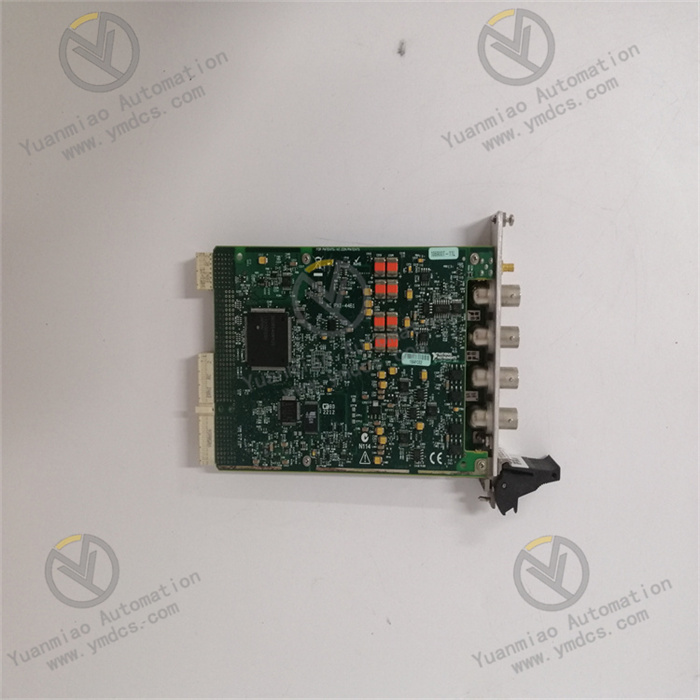
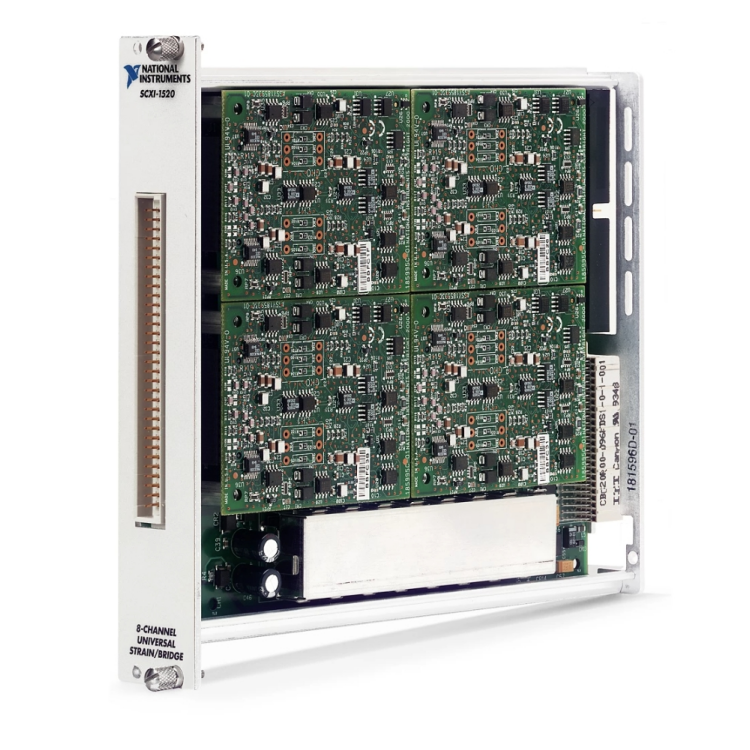
NI SCXI-1520 is an 8-channel general-purpose strain/bridge sensor signal conditioning module designed exclusively for SCXI architecture. It serves as the core strain signal conditioning component in industrial testing and high-precision data acquisition systems. It is used for signal amplification, filtering and bridge excitation of sensors such as strain, force, torque and pressure, and acts as essential equipment to realize high-precision strain signal acquisition in structural testing, industrial monitoring and precision measurement applications.
It mainly provides programmable excitation, precision amplification, anti-aliasing filtering and synchronous sampling functions for various strain gauges including full bridge, half bridge and quarter bridge. It completes signal conditioning near the sensors directly, effectively reducing noise interference caused by long-distance transmission and improving measurement accuracy. Integrated with hardware auto-zero, remote sensing and shunt calibration functions, it fully meets high-precision measurement requirements in harsh industrial environments.
2. Technical Specifications
2.1 Core Electrical & Measurement Specifications
- Channel Configuration: 8 differential analog input channels with independent channel configuration, supporting synchronous sampling, maximum bandwidth up to 10kHz.
- Bridge Compatibility: Compatible with 120Ω/350Ω/1000Ω strain gauges; supports full bridge, half bridge and 3-wire compensated quarter bridge configurations. Half-bridge network is built-in, and quarter-bridge compensation resistors are integrated into terminal blocks.
- Excitation Voltage: Each channel supports independently programmable DC 2.5V/3.3V/5V/10V, maximum bridge voltage 10V, supporting remote sensing to compensate lead voltage drop.
Gain Range: Software programmable gain from 1 to 1000 with more than 40 precision gain levels; input range covers ±10V to ±1mV, suitable for weak strain signal measurement.
- Filter Characteristics: 4th-order programmable low-pass Bessel filter with adjustable cutoff frequency to suppress high-frequency noise and aliasing interference.
- Calibration Functions: On-board NIST-traceable calibration reference voltage; supports hardware auto-zero, shunt calibration and offset compensation; built-in calibration EEPROM for storing calibration constants.
Driver Compatibility: Compatible with NI-DAQ 7.0 and above; supports development environments such as LabVIEW, Measurement Studio and C/C++.
2.2 Physical & Structural Specifications
- Installation Method: Standard slot installation for SCXI chassis, compatible with SCXI-1000 (4-slot), SCXI-1001 (12-slot) and other chassis, supporting multi-module stacking and expansion.
- Dimensions: 30.5mm × 172.7mm × 198.1mm (H × W × D), conforming to standard SCXI series packaging.
- Weight: Approximately 680g, lightweight industrial design for easy field installation and cabinet deployment.
- Interface & Enclosure: Industrial-grade metal shielded housing with excellent anti-electromagnetic interference performance; SCXI bus interface at the rear and dedicated interface for SCXI-1314/SCXI-1314T terminal blocks at the front for convenient wiring.
Environmental Adaptability: Operating temperature: 0℃~50℃; Storage temperature: -40℃~70℃; Operating humidity: 10%~90% non-condensing, suitable for industrial sites and laboratory environments.
2.3 Core Functions & Compatibility Specifications
- Core Functions: Strain/bridge sensor signal conditioning, multi-channel synchronous sampling, programmable excitation and amplification, anti-aliasing filtering, hardware auto-zeroing, remote sensing calibration and flexible bridge configuration adaptation.
Integrated Features: Highly integrated design enables complete signal conditioning for 8 strain channels by single module without extra conditioning devices. Built-in track-and-hold circuit realizes multi-channel synchronous sampling to ensure measurement consistency.
- Compatibility: Matches full-series NI SCXI chassis and terminal blocks; compatible with E/M series DAQ cards and SCXI-1600 USB acquisition modules; supports Windows and Linux operating systems for seamless integration into NI data acquisition ecosystem.
- Reliability & Practicability: Industrial reinforced design with vibration and electromagnetic interference resistance. All channels operate independently, so single-channel faults will not affect others. Status indicators clearly display operating status for convenient on-site troubleshooting.
3. Working Principle
After being inserted into the SCXI chassis and powered on, the module automatically completes self-test and initialization to check the status of channels, excitation sources, amplifiers and filter circuits. Users configure bridge type (full/half/quarter bridge), excitation voltage, gain and filter parameters via NI-DAQ software to finish matching between sensors and the module.
The module supplies stable DC excitation voltage to strain bridges. When strain gauges deform under external force, the bridge outputs weak differential voltage signals. Such signals are amplified by front-end instrumentation amplifiers and filtered by 4th-order low-pass filters to eliminate high-frequency noise and retain valid strain signals.
The built-in track-and-hold circuit achieves synchronous sampling of 8 channels to guarantee time consistency of multi-channel data. The hardware auto-zero circuit eliminates amplifier offset and bridge zero-point errors in real time, and the remote sensing function compensates voltage drop on excitation leads to improve measurement accuracy.
Conditioned analog signals are transmitted to rear-end DAQ cards through SCXI bus for digital conversion. Built-in calibration constants automatically correct gain and offset errors. Shunt calibration is available to simulate known strain values and calibrate system gain so as to ensure measurement accuracy.
4. Application Scenarios
4.1 Aerospace Structural Testing
4.2 Automotive Industry R&D and Testing
4.3 Civil Engineering & Infrastructure Monitoring
Applied to long-term strain monitoring of bridges, dams and building structures. It collects real-time structural stress data, gives early warnings of structural damage risks and ensures safe operation of infrastructure.
4.4 Energy & Power Equipment Monitoring
4.5 Industrial Automation & Precision Manufacturing