Description
ABB 07KT97 GJR5253000R4270
1. Basic Information
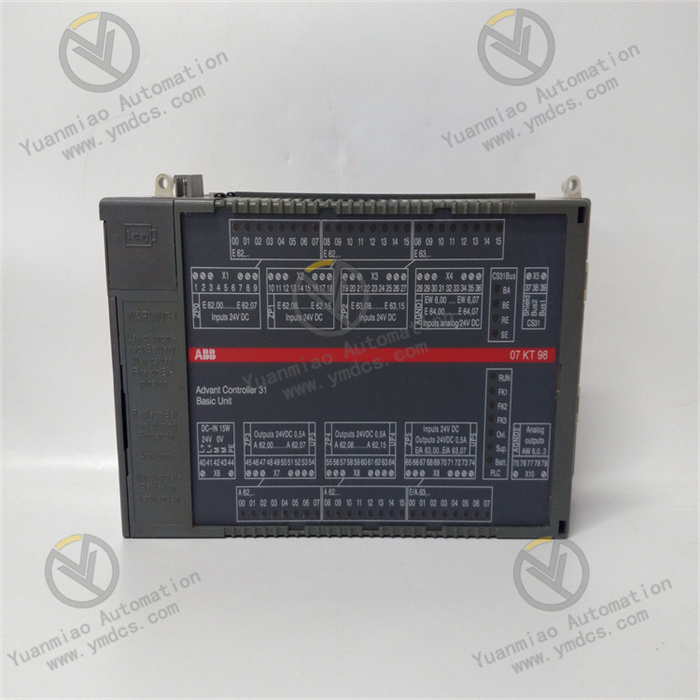
ABB 07KT97 (Part No. GJR5253000R4270) is an integrated programmable CPU controller for ABB Freelance / Advant Controller 31 series, serving as a compact all-in-one industrial main control unit. Integrated with CPU core, native analog I/O channels, high-speed counter, multi-protocol communication interfaces and CS31 system bus, it can independently complete logic operation, process regulation, signal acquisition and equipment control for small and medium-sized automatic systems without additional basic I/O modules. It is the core main control device for ABB hybrid small-scale DCS and PLC control systems.
Featuring integrated design, cost-effectiveness, multi-protocol compatibility and flexible expansion, it adopts a high-performance industrial processor and supports multiple standard industrial protocols and high-speed pulse counting. Equipped with 8 analog inputs, 4 analog outputs and a high-frequency counting channel, and supporting CS31 remote I/O expansion bus, it meets both compact standalone control and distributed expansion requirements. It is widely used in water treatment, HVAC, light industry, chemical auxiliary units and small power station automation systems for aging CPU replacement, small automatic system renovation and distributed station main control upgrading.
2. Technical Specifications
2.1 Core Main Control Performance
- Device Type: All-in-one CPU main control unit integrating I/O, operation, communication and expansion bus functions for independent standalone operation
- System Compatibility: ABB Freelance, Advant Controller 31, Advant OCS control systems
- Processor Performance: High-performance industrial processor with fast operation and short logic scan cycle for real-time process control
- Programming Standard: Compliant with IEC 61131 international standards, supporting ladder diagram, function block, structured text and other mainstream programming languages
- Control Functions: Supports full industrial control functions including closed-loop PID regulation, logic interlock, sequence control and high-speed counting operation
2.2 Integrated I/O Channel Specifications
- Analog Input (AI): 8 configurable channels, compatible with voltage, current, Pt100 RTD and digital signals, 10-bit + sign high-precision sampling
- Analog Output (AO): 4 configurable channels, supporting standard voltage and current output for regulating valves, frequency converters and instrument control
- High-speed Counter: 1-channel max 50kHz high-speed counter with 7 operating modes, suitable for pulse speed measurement, positioning and high-frequency metering
- Signal Performance: Supports bipolar signal processing with high channel isolation, low temperature drift and high linearity for high-precision process regulation
2.3 Communication & Expansion Specifications
- Ethernet Interface: Built-in industrial Ethernet port, supporting Modbus TCP/IP and Ethernet/IP for upper computer, HMI and remote system networking
- Serial Interface: Dual RS-485 ports (COM1/COM2) for data interaction with serial peripherals, instruments and slave devices
- Expansion Bus: Native CS31 (EIA RS-485) system bus for remote I/O module networking and point expansion
- Bus Protocol: Compatible with Profibus DP and other mainstream industrial buses for integration into large-scale bus control systems
2.4 Power Supply Specifications
- Rated Voltage: Standard industrial 24V DC power supply compatible with general industrial control cabinet power systems
- Voltage Tolerance: Tolerates minor on-site voltage fluctuations for long-term uninterrupted operation
- Power Protection: Built-in over-voltage, over-current, reverse polarity and surge protection against grid fluctuation and wiring errors
- Power Consumption: Low-power integrated architecture with low heat generation and stable full-load long-term operation
2.5 Environmental & Physical Specifications
- Operating Temperature: 0℃~+60℃ industrial temperature range for closed cabinet operation
- Storage Temperature: -25℃~+75℃ with excellent temperature resistance and anti-aging performance
- Humidity Range: 5%~95%RH (non-condensing), dust-proof and moisture-proof for standard industrial environments
- EMC Performance: Compliant with industrial EMC standards, resisting on-site electromagnetic radiation, frequency conversion interference and signal crosstalk
- Installation Mode: Standard DIN rail mounting, easy installation, vibration-resistant and stable
- Weight: Approx. 0.9kg, lightweight and compact design for cabinet space saving
2.6 Diagnosis & Protection Specifications
- Power-on Self-test: Automatically inspects CPU core, I/O channels, communication ports, bus loops and storage units after power-on
- Real-time Diagnosis: Continuously monitors channel disconnection, over-range, communication timeout, bus abnormality, power failure and program errors
- Fault Tolerance: Automatically locks output and stops dangerous logic under abnormal conditions, uploads fault codes to avoid process mis-operation
- Status Indication: Built-in running, communication and fault LEDs for intuitive on-site maintenance and troubleshooting
- Data Protection: Power-down protection for key programs and process parameters, automatic recovery after restart without reconfiguration
3. Working Principle
- Power-on Initialization & Self-test: After 24V DC power-on, the module automatically completes hardware self-inspection, firmware loading, program initialization and port handshake. It verifies the integrity of all channels and bus loops and enters standby operation after passing self-test.
- On-site Signal Acquisition & Preprocessing: It collects on-site analog signals such as temperature, pressure, flow and liquid level through 8 analog input channels, and captures high-frequency pulse signals via the high-speed counter. Signals are preprocessed through hardware filtering, calibration and range conversion.
- Core Logic Operation & Closed-loop Control: The CPU cyclically scans according to preset IEC programs, completes process logic interlock, sequence control, PID closed-loop regulation and data comparison operation, and generates accurate control commands based on real-time process parameters.
- Local Output & Remote Expansion Control: It drives on-site regulating valves, frequency converters and instruments through 4 analog output channels. Meanwhile, it connects remote I/O modules via CS31 bus to realize distributed measurement acquisition and equipment control and expand system control scope.
- Multi-protocol Data Interaction: It uploads operating data and equipment status to upper computers, HMIs and remote monitoring systems via Ethernet and serial ports, and receives remote control commands to complete human-machine interaction and remote management. Multi-bus compatibility supports integration into large main control systems for network linkage.
- Full-process Monitoring & Fault Protection: It real-timely monitors power supply, channels, communication and program operation status. It immediately triggers protection mechanisms, locks output, records fault information and uploads alarms during faults, avoiding equipment mis-operation and process runaway to ensure safe and continuous system operation.
4. Application Scenarios
4.1 Small & Medium-sized Automatic Complete Control System
With all-in-one integrated design, it independently completes full automation control for small production lines, auxiliary process units and independent sections without additional I/O modules. It simplifies cabinet structure and reduces equipment and wiring costs, widely applied in light industry, HVAC and water treatment standalone equipment automatic control.
4.2 High-precision Analog Regulation Process
Relying on high-precision analog sampling, bipolar signal processing and stable PID regulation capability, it adapts to high-precision closed-loop control of temperature, pressure, flow and liquid level, meeting accurate control requirements of chemical auxiliary processes, water treatment filtration and heat exchange units.
4.3 High-speed Pulse & Motion Metering Control
Equipped with a 50kHz high-speed multi-mode counter, it accurately completes equipment speed measurement, positioning, pulse counting and high-frequency flow accumulation. It is suitable for conveying equipment, metering devices and small motion control scenarios, solving high-frequency signal sampling distortion of ordinary controllers.
4.4 Distributed Remote I/O Expansion Control System
It supports remote I/O networking via native CS31 bus, expanding from compact standalone control to distributed control system. It adapts to scattered factory measurement points and long-distance equipment management, balancing the compactness of small cabinets and scalability of large systems.
4.5 Compatible Upgrade & Replacement of Old ABB Control Systems
Fully compatible with aging ABB Freelance and AC31 control systems, it directly replaces outdated main CPUs and solves common problems such as slow operation, channel failure, unstable communication and inability to adapt to high-frequency processes. It upgrades automatic system performance at low cost without modifying cabinet wiring and process logic.