I. Basic Information
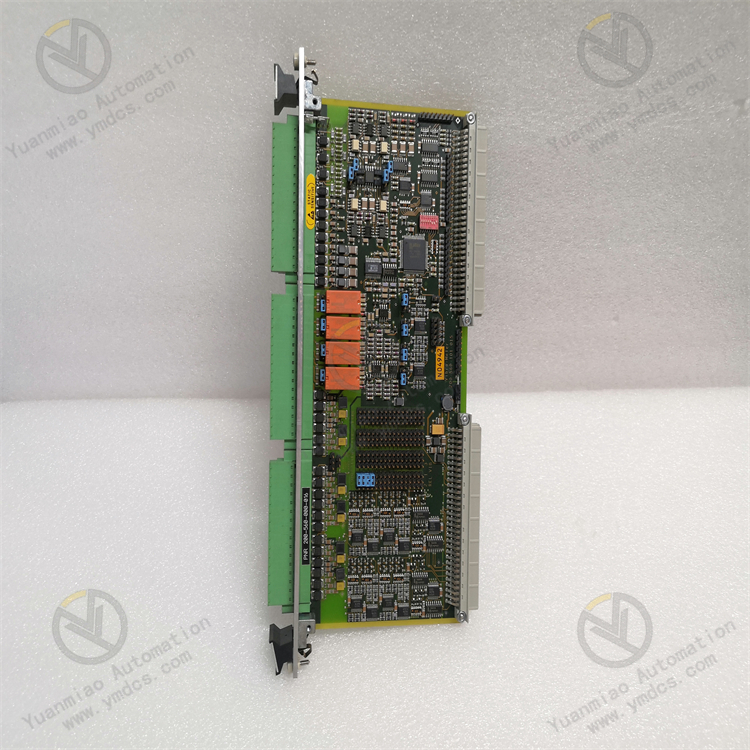
Model:VM600 IOC4T (Dual Part No.: 200-560-000-111 / 200-560-101-017)
Brand:VIBRO-METER (original compact 4-channel programmable IO interface card for VM600 machinery condition monitoring systems)
Product Positioning
The VIBRO-METER VM600 IOC4T is a compact 4-channel programmable IO signal interface module for VM600 Mk1/Mk2 machinery condition monitoring and protection systems, exclusively matched with MPC4 machinery protection cards. It serves as the core signal interaction bridge between on-site sensors, process switches, interlock loops and system main control units. The module undertakes switch status collection, process contact signal reception, system alarm output and local interlock feedback interaction for small units and auxiliary equipment. Adapted to rotating power equipment such as steam turbines, gas turbines, fans and water pumps, it is designed for light-weight configuration, local signal expansion and precise signal interaction scenarios of VM600 systems, widely used in auxiliary equipment condition monitoring and safety interlock scenarios in thermal power, chemical and metallurgical industries.
Hardware Architecture
Adopting industrial-grade compact high-density isolated IO architecture, the module integrates 4 fully independent programmable signal channels, each equipped with an independent optoelectronic isolation unit, signal shaping circuit, fault self-inspection chip and logic drive loop. All channels are completely electrically isolated without crosstalk, fault coupling or signal interference. Exclusively matched with MPC4 protection cards, it realizes high-speed data interaction through the rack backplane bus, compatible with on-site active/passive switch signals and 24VDC level signals. It includes two versions: the basic version 200-560-000-111 for conventional signal acquisition and output; the enhanced version 200-560-101-017 with optimized EMC anti-interference circuit, improved sampling accuracy and faster channel response. Both versions feature identical rack positioning, terminal definition and communication protocol, supporting lossless replacement and mixed system upgrading. The reinforced board design supports 7×24-hour uninterrupted cabinet operation with dust-proof, vibration-resistant and anti-aging performance.
Mounting Specification
Designed for slot installation of standard VM600 ABE04X and ABE055 racks with accurate positioning and stable backplane bus docking for compact rack layout. It supports standard online hot-swap function, enabling module disassembly, replacement and maintenance during normal unit operation without equipment shutdown, system power cut or parameter reset, without affecting the protection logic of the entire monitoring system. The compact and well-partitioned channel layout adapts to new lightweight system supporting, local IO expansion of old systems, faulty module replacement and signal loop technical transformation with excellent on-site adaptability.
Compatible Systems
Fully compatible with VM600 Mk1/Mk2 full-series rack-mounted monitoring and protection systems, it serves as the exclusive supporting IO module for MPC4 machinery protection cards, working seamlessly with CPUM main control modules, RPS6U redundant power modules and RLC16 relay output modules. The dual models are fully interoperable in hardware and protocol for arbitrary replacement and upgrading. It seamlessly connects with power plant DCS, PLC control systems, local equipment interlock loops and sound-light alarm devices to realize auxiliary equipment status collection, alarm output, interlock feedback and remote command interaction, fully integrating into the unit automatic monitoring and safety protection system.
Product Characteristics
4 fully independent programmable IO channels support free input/output configuration to adapt to diverse switch signal scenarios. Single-channel faults are isolated independently without affecting other channels or the whole system. High-speed optoelectronic isolation eliminates on-site electromagnetic interference, ground circulation and voltage surges to ensure accurate signal collection and stable logic output. Built-in full-channel real-time self-inspection accurately identifies line disconnection, short circuit, signal abnormality and hardware faults with real-time alarm upload. The enhanced version optimizes anti-interference and response performance for harsh working conditions. Featuring compact structure, low power consumption and stable long-term operation, it supports shutdown-free hot-swap maintenance to reduce lightweight system operation and maintenance costs.
II. Technical Specifications
1. Core Channel Parameters
Channel Configuration: 4 fully independent programmable IO channels operate in parallel with complete electrical isolation and no mutual interference, designed for low-measuring-point and precise signal interaction scenarios. Channel Mode: Bidirectional programmable design supports switch signal input, equipment status feedback input, alarm contact output and interlock command output to adapt to various on-site process contacts and control loops. Version Difference: 200-560-000-111 basic version meets standard signal acquisition and output for conventional working conditions; 200-560-101-017 enhanced version upgrades anti-interference filter circuit and signal sampling algorithm, improving channel response speed and fault identification accuracy for harsh environments with strong electromagnetism and grid fluctuation. Both versions are fully compatible for lossless replacement. Channel Isolation: Independent single-channel optoelectronic isolation completely blocks inter-channel crosstalk, ground potential difference interference and reverse voltage impact to ensure authentic and reliable signals.
2. Electrical Operating Parameters
Operating Power Supply: Adapts to dedicated VM600 rack DC regulated power supply, featuring wide voltage anti-fluctuation, low power consumption and low heat generation, with no accelerated device aging or power drift during long-term continuous operation, adapting to closed cabinet heat accumulation conditions. Signal System: Compatible with industrial standard 24VDC active level signals, passive dry contact signals, local interlock switch signals and equipment start-stop status feedback signals, matching most auxiliary equipment IO signal specifications. Response Performance: High-speed signal response mechanism ensures no delay in signal collection, logic forwarding and command output, instantly capturing equipment condition changes and interlock trigger signals without omission or lag to guarantee real-time auxiliary equipment monitoring. Load Capacity: Stable output channel driving capability reliably drives local indicators, small alarm devices and auxiliary interlock loops with jitter-free and error-free signal output.
3. Communication & Interaction Parameters
Bus Interaction: Real-time high-speed data interaction with MPC4 monitoring cards and CPUM main control modules via dedicated rack backplane bus ensures stable transmission, no data loss and no communication delay, maintaining complete synchronization between IO signals and system logic. Data Transmission: Supports real-time full-channel status upload, remote channel parameter configuration and real-time fault code push, enabling visualized IO status monitoring and fault traceability by connecting to upper monitoring systems. System Linkage: Accurately responds to alarm, interlock and reset commands issued by the main control system, synchronously feeds back on-site equipment operating status, and realizes full closed-loop control of auxiliary equipment monitoring, judgment, output and linkage.
4. Environmental Operating Parameters
Operating Temperature:-20℃~+60℃, maintaining stable channel sampling accuracy, isolation performance, communication and logic output in the full temperature range, adapting to harsh cabinet conditions with temperature fluctuation and long-term operation in power, chemical and metallurgical industries.
Storage Temperature:-40℃~+70℃, no device aging, parameter drift, board deformation or channel performance failure during long-term storage.
Operating Humidity:5%~95% RH, non-condensing, adapting to humid, slightly dusty industrial environments without circuit dampness, insulation degradation or channel abnormality.
Condition Adaptation: Passed industrial EMC electromagnetic compatibility, vibration and impact resistance tests, stably resisting on-site strong electromagnetic radiation, equipment high-frequency vibration, grid harmonic disturbance and transient voltage impact. Protection Grade: Industrial-grade reinforced board structure with excellent dust-proof, moisture-proof, anti-corrosion and anti-interference performance, fully adapting to long-term 7×24-hour uninterrupted indoor cabinet operation.
III. Key Features
1. 4-Channel Independent Programmable for Lightweight & Precise Signal Interaction
Equipped with 4 fully independent programmable IO channels supporting customized single-channel input/output configuration, the module flexibly adapts to lightweight signal scenarios such as auxiliary equipment start-stop status collection, local interlock switch feedback, process over-limit contact collection, system alarm output and remote command interaction. All channels are completely electrically isolated, and single-channel line faults, signal abnormalities and loop short circuits will not affect other channels and the whole system. With strong fault tolerance, it perfectly meets the low-measuring-point and high-precision signal monitoring requirements of small units and auxiliary equipment.
2. Full Compatibility of Dual Versions for Lossless Iterative Upgrading
The basic version 200-560-000-111 and enhanced version 200-560-101-017 are fully compatible in hardware size, rack positioning, terminal definition, bus protocol and software configuration, enabling direct bidirectional lossless replacement without system program modification, rewiring or parameter resetting. The enhanced version optimizes electromagnetic anti-interference capability and signal response speed for complex industrial conditions, effectively solving signal drift, sampling distortion and response lag in strong interference environments, adapting to quality improvement transformation of old systems and high-standard supporting of new systems.
3. Optoelectronic Isolation Anti-Interference Ensures Accurate & Stable Signals
Full-channel high-speed optoelectronic isolation design completely isolates complex on-site electromagnetic interference, grid harmonics, ground circulation and voltage surge impact, eliminating hidden dangers such as signal drift, sampling distortion, logic misjudgment and interlock misoperation at the terminal level. It ensures the authenticity and stability of each switch signal under harsh working conditions such as humidity, dust and strong electromagnetic radiation, providing reliable signal support for auxiliary equipment safety interlock and condition monitoring.
4. Full-Channel Real-Time Self-Inspection for Traceable & Controllable Faults
The built-in full-channel comprehensive fault self-inspection mechanism monitors line continuity, signal amplitude, hardware condition and loop status of each channel 24/7, accurately identifying hidden faults such as line disconnection, short circuit, signal over-limit, channel hardware abnormality and communication failure. When a fault occurs, it immediately locks the faulty channel, records fault points and uploads alarm information, enabling operation and maintenance personnel to quickly locate and troubleshoot hidden dangers, realizing full-time controllable and traceable IO loop operation, and ensuring stable operation of auxiliary equipment monitoring and protection systems.
5. Hot-Swap Shutdown-Free Maintenance Adapts to Continuous Production
Supporting online hot-swap replacement for VM600 racks, faulty modules can be disassembled, replaced and maintained during normal operation of units and auxiliary equipment without equipment shutdown, system power cut or parameter reset. It perfectly adapts to continuous production scenarios where equipment monitoring and protection cannot be interrupted in power stations, chemical and metallurgical industries, greatly reducing maintenance shutdown losses and improving system operation rate and maintainability.
IV. Working Principle
The VIBRO-METER VM600 IOC4T IO module operates based on the independent channel optoelectronic isolation + programmable function configuration + real-time status collection + main control command analysis & output + full-channel fault self-inspection principle. As a lightweight signal interaction terminal exclusively for the VM600 system MPC4 monitoring card, it realizes two-way signal intercommunication between on-site auxiliary equipment and the main control system. The workflow includes five core links: signal isolation preprocessing, channel function configuration, status data upload, logic command execution and fault self-inspection locking.
During normal system operation, the 4 independent channels of the IOC4T module complete input/output function configuration according to preset system parameters. The input channels collect switch signals such as on-site auxiliary equipment start-stop status, local interlock switches, process over-limit contacts and equipment fault feedback in real time. After optoelectronic isolation, filtering and noise reduction, and signal shaping preprocessing, the purified and stable status signals are uploaded to the MPC4 monitoring card and CPUM main control module via the backplane high-speed bus for system condition judgment, parameter calculation and logic decision. The output channels receive real-time logic commands such as alarm, interlock and status reset from the main control system, and output standard switch signals after drive amplification and isolation protection to drive local alarm devices and auxiliary interlock loop actions.
Throughout operation, the built-in self-inspection unit continuously monitors the line conditions, signal effectiveness and hardware operating status of all channels in real time, dynamically comparing the consistency of input and output signals. Under normal working conditions, it stably completes signal collection/upload and command output/execution. When line disconnection, short circuit, signal abnormality or channel fault occurs, it immediately locks the faulty channel, shields abnormal signals and uploads system alarms to prevent abnormal signals from interfering with system logic operation. The enhanced version features optimized signal processing algorithms and anti-interference circuits for stronger signal stability and fault identification accuracy under complex electromagnetic conditions. Both versions share identical core working logic to ensure long-term reliable system operation.
V. Application Scenarios
1. Auxiliary Equipment Status Signal Collection: Collects switch signals such as start-stop status, local interlock, process over-limit and fault status of auxiliary power equipment such as fans, feed water pumps, circulating pumps and small compressors to provide data support for auxiliary equipment condition monitoring.
2. Lightweight System Alarm & Interlock Output: Receives and executes main control system logic commands, outputs switch signals such as alarm prompt, status indication, auxiliary interlock and fault reset, and drives local sound-light alarms and small interlock loops to realize auxiliary equipment safety protection.
3. Local IO Expansion & Technical Transformation of Old Systems: Used for lightweight technical transformation and upgrading of old VM600 systems with insufficient local measuring points, aging modules and faulty signal loops. Dual-model compatible replacement improves the stability of local signal interaction.
4. Supporting Signal Interaction for Small Units: Adapts to lightweight monitoring systems of small gas turbines and steam turbines, realizing two-way transmission of equipment status signals and docking with DCS/PLC upper systems to complete automatic unit management and control.
5. Local Signal Monitoring Under Harsh Working Conditions: Applied to strong-interference, humid and dusty working conditions in chemical industry and self-provided power stations, ensuring accurate signals and reliable interlocks of local key measuring points and avoiding misoperation risks of auxiliary equipment relying on optoelectronic isolation and anti-interference design.