Description
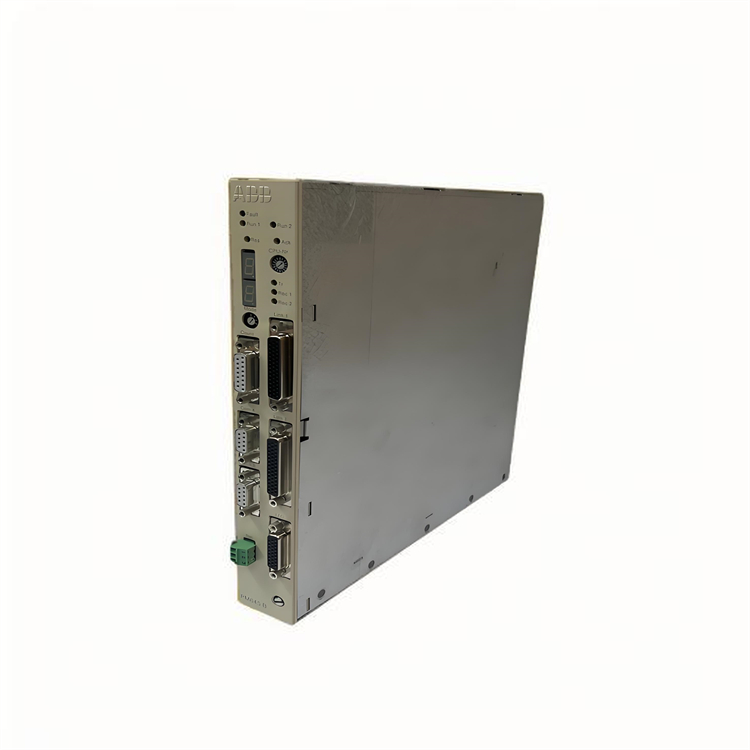
ABB REF542plus
The ABB REF542plus is a highly integrated digital multi-functional protection, control and monitoring terminal. As an enhanced and upgraded version of the REF542 series, it is specifically designed for medium-voltage (MV) distribution systems (typically with a voltage rating of 6.6kV-36kV, and primarily adapted for 10-36kV). Integrating protection, control, metering, communication, monitoring and power quality analysis in one unit, it has become a core terminal device for modern intelligent distribution networks by virtue of its flexible configuration, high reliability and modular design, and is widely compatible with various Air-Insulated Switchgear (AIS) and Gas-Insulated Switchgear (GIS).
I. Product Positioning and Design Philosophy
The core positioning of the REF542plus is to provide a compact, all-in-one and flexibly adaptable protection and control solution for medium-voltage distribution systems. It breaks the limitations of traditional single-function devices by integrating multiple core functions into a single unit, simplifying the secondary system design of medium-voltage switchgear and reducing equipment deployment and operation & maintenance (O&M) costs. Its design adheres to the three core principles of universality, flexibility and reliability, and supports task separation design that allows flexible adjustment of protection and control schemes according to actual application scenarios. Meanwhile, it features full life cycle traceability, complies with mainstream global power industry standards (e.g., protection algorithms conform to IEC 60255), and is adaptable to the distribution system requirements of different regions.
II. Hardware Structure and Installation Characteristics
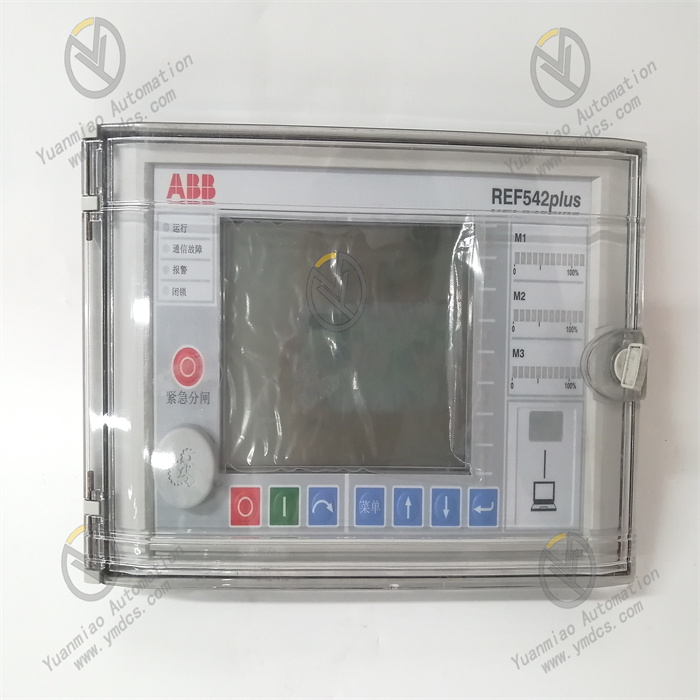
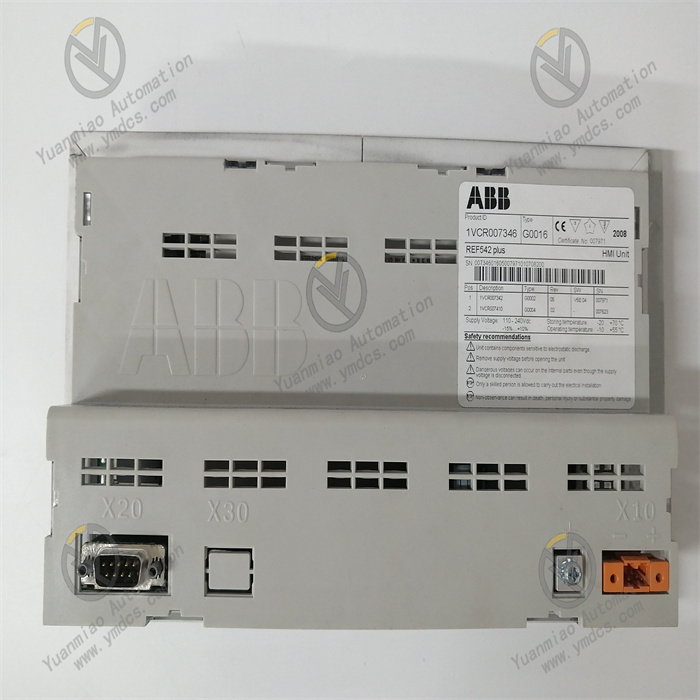
The REF542plus adopts a modular split design and consists of two main parts: the Base Unit and an independent Human-Machine Interface (HMI). The two parts are connected via a serial cable, enabling flexible installation and deployment to adapt to the installation space requirements of different switchgear.
1. Base Unit
- Power supply module: Provides stable power supply for the entire device to ensure continuous operation in complex power grid environments.
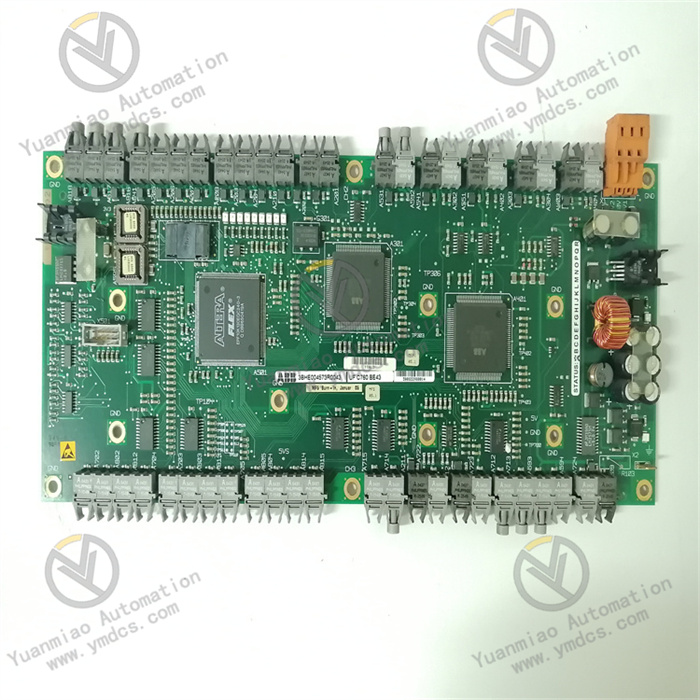
- Processor board and control DSP: Equipped with high-performance processing chips, responsible for protection logic operation, metering data processing and control command execution respectively to ensure response speed and operational accuracy.
- Analog input board: Compatible with instrument transformers and non-inductive sensors, it can collect core electrical signals such as primary current and voltage. It also supports an optional 4-20mA analog input module to expand the signal acquisition range.
- Binary input/output (I/O) module: Used for interface interconnection with external equipment (e.g., circuit breakers, contactors) to realize switch status acquisition and control command output.
- Optional functional modules: Including analog output module (0(4)-20mA), communication module, optical input clock synchronization port, etc., which can be flexibly selected and configured according to actual needs to improve device expandability.
2. Human-Machine Interface (HMI)
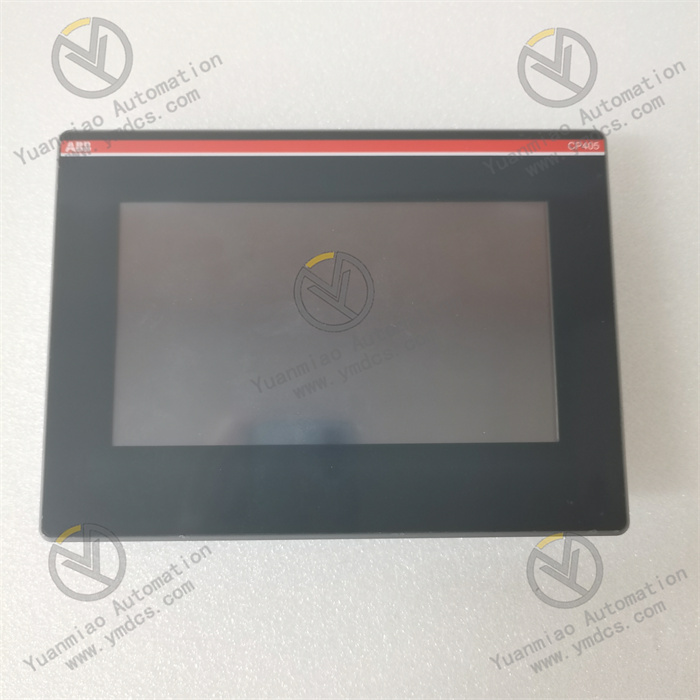
- Equipped with a large multi-language LCD display, which can intuitively display one-line diagrams, text information and menu content, and support protection parameter setting, local operation of switchgear, and visualization of events and metering data.
- Connected to the Base Unit via shielded and isolated twisted pair cables complying with the RS-485 standard to ensure communication stability and avoid interference.
- Supports local event traceback, parameter query and modification, enabling daily O&M operations to be completed without external tools and improving O&M convenience.
3. Installation and Environmental Characteristics
The device features a compact overall design, adapted to the standard installation space of medium-voltage distribution switchgear, and can be directly embedded in AIS or GIS switchgear. It has excellent anti-interference and harsh environment resistance capabilities, complies with industrial-grade equipment standards, and can operate stably for a long time in complex power scenarios. It also supports an Ethernet interface and a built-in web server, enabling remote access and configuration via a browser to further enhance the flexibility of installation and O&M.
III. Functions
The REF542plus integrates five core functions, covering the full scenarios of protection, control, metering, monitoring and communication for medium-voltage distribution systems. The functions can be flexibly configured according to application requirements, and it is adaptable to the protection and control needs of various equipment such as feeders, transformers and motors.
1. Protection Functions (Core Functions)
- Overcurrent protection: Including phase-to-phase overcurrent and earth fault overcurrent protection, which can accurately monitor line overload and short-circuit faults.
- Directional overcurrent protection: Adapted to ring network or dual-power supply systems to improve fault selectivity and system stability.
- Equipment-specific protection: Covering transformer protection and motor thermal overload protection, adaptable to the protection needs of different types of loads.
- Auxiliary protection functions: Including circuit breaker failure protection, under/over voltage protection, frequency abnormality protection, spring charging time monitoring, trip coil monitoring, etc., fully covering various potential fault scenarios in distribution systems.
- Protection flexibility: Supports programmable configuration of protection parameters. Users can enable or adjust protection functions on demand through the Relion Engineering Tool (RET6xx) software to adapt to the personalized needs of different application scenarios.
2. Metering Functions
- Current parameters: Capable of measuring the maximum and average current within a set monitoring period (0-30 minutes).
- Electrical energy and operation parameters: Including total interrupting current, equipment operation time and switch operation times.
- Power quality parameters: Capable of monitoring power quality indicators such as Total Harmonic Distortion (THD) and flicker to facilitate energy efficiency optimization.
- Data storage and display: Metering data can be stored locally, inquired via HMI or remote communication interface, and supports data export for easy O&M analysis and report generation.
3. Control Functions
- Local control: Direct operation of switchgear actions such as opening, closing and auto-reclosing via HMI to realize local O&M control.
- Remote control: Access to substation automation systems or SCADA systems via communication interfaces to issue remote control commands and realize unattended O&M.
- Interlocking control: Supports interconnection with external equipment (e.g., UPS systems, PLCs). For example, interlocking with UPS via under-voltage/frequency protection to ensure the power supply continuity of critical loads.
- Automatic control: Supports automatic control logic such as auto-reclosing, which can automatically execute control actions according to the operation status of the power grid to improve the reliability of the distribution system.
4. Monitoring and Self-Diagnosis Functions
- Equipment status monitoring: Real-time monitoring of spring charging time, trip coil status, external equipment interface status, etc., and timely feedback of equipment abnormalities.
- Self-diagnosis function: Capable of self-diagnosing its own hardware modules (e.g., power supply, I/O modules, communication modules), and issuing alarms in a timely manner when faults are detected to facilitate rapid fault location and maintenance.
- Event recording: Capable of recording detailed information of fault events and operation events (e.g., event time, fault type, operation content), and supports event traceback to provide a basis for fault analysis.
- Life cycle monitoring: Features full life cycle traceability, and can record the whole life cycle operation data of the device to provide support for the whole life cycle management of the equipment.
5. Communication Functions
- Standard communication interface: Supports RS-485 interface, compatible with the Modbus RTU protocol, and can be integrated with mainstream PLC and SCADA systems.
- Optional communication module: Supports Ethernet module, compatible with the IEC 61850-8-1 GOOSE/MMS protocol, and can access ABB Ability™ or third-party substation automation systems to meet the digital requirements of intelligent substations.
- Built-in web server: Access via a browser through the Ethernet interface to realize remote parameter configuration, data query and status monitoring without installing special software.
- Clock synchronization: Supports an optional optical input port to realize high-precision clock synchronization and ensure the time consistency of event recording and data acquisition.
- Communication security: Supports IPsec function, with security mechanisms such as user identity authentication and operation permission control to prevent remote attacks and misoperations. It also supports a variety of network topologies (bus, star, ring), which can be flexibly deployed according to the distribution system architecture, and supports redundant ring network topology to improve communication reliability.
IV. Application Scenarios
- Substations and distribution networks: Served as a core protection and control terminal in medium-voltage substations (AIS/GIS switchgear), it can quickly isolate fault areas to ensure the overall reliability of the distribution network, and is adaptable to the protection and control needs of feeders, transformers and other equipment.
- Industrial power systems: Applicable to industrial scenarios such as manufacturing, chemical plants, mines and oil platforms to protect main distribution feeders, large motors (e.g., air compressors, water pumps) and workshop transformers, preventing production interruptions caused by faults such as short circuits and overloads.
- New energy field: Adapted to the power protection of new energy power generation systems such as wind power generation and solar inverters to ensure the stable operation of clean energy systems and realize efficient interconnection between new energy and distribution networks.
- Critical infrastructure: Applied in scenarios such as hospitals, data centers, municipal water plants, sewage treatment plants, commercial complexes and rail transit traction substations to ensure the power supply continuity of critical loads. Through precise protection and interlocking control, it avoids business interruptions or safety risks caused by power faults.
V. Product Advantages and Feature Summary
- High integration: Integrates protection, control, metering, communication, monitoring and other functions into a single compact device, simplifying the secondary system design and reducing equipment deployment costs.
- Flexible adaptability: Supports the protection and control needs of a variety of equipment (feeders, transformers, motors). The modular design allows flexible selection and configuration of functional modules, and the task separation design facilitates the adjustment of protection and control schemes.
- Convenient O&M: The independent HMI supports local operation and maintenance, and the built-in web server enables remote management and control. The self-diagnosis and event recording functions help with rapid fault location and reduce O&M workload.
- High reliability: With an industrial-grade design, it has excellent anti-interference and harsh environment resistance capabilities, supports redundant communication topology, ensures long-term stable operation of the device, and complies with global power industry standards.
Intelligent adaptability: Supports mainstream communication protocols such as IEC 61850, enabling seamless access to intelligent distribution automation systems. It has power quality monitoring capability to provide data support for intelligent distribution and predictive maintenance.