Description
ABB AI820 3BSE008544R1
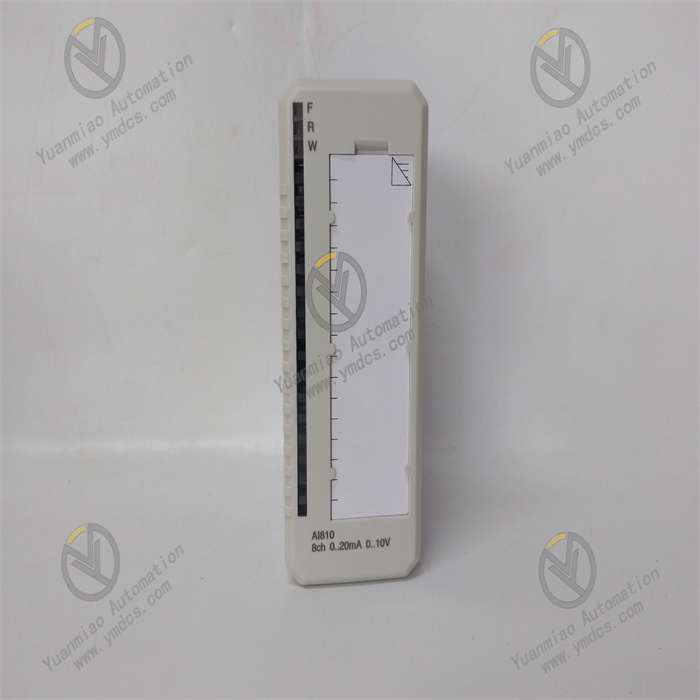
The ABB AI820 3BSE008544R1 is an analog input module. As a key I/O component of the AC 800M series distributed control system (DCS), it is widely used in fields with strict requirements for parameter acquisition accuracy and reliability, such as power generation, petrochemical engineering, precision metallurgy, and biopharmaceuticals. This is attributed to its 16-channel high-density acquisition, 24-bit ultra-high-precision conversion, and wide-range environmental adaptability. It undertakes the tasks of accurate acquisition and preprocessing of continuous process parameters including temperature, pressure, flow rate, liquid level, and composition. Its core technical advantages lie in the adoption of an enhanced ΔΣ A/D conversion architecture and full-channel independent isolation design. While realizing 16-channel synchronous sampling, it improves the measurement accuracy to ±0.01% FS. It can seamlessly collaborate with the ABB AC 800M controller and the System 800xA monitoring platform to build a full-link process monitoring system of "on-site perception - accurate acquisition - intelligent processing - stable transmission". It provides highly reliable data support for closed-loop control and lean management of industrial processes, and is a benchmark acquisition component in mid-to-high-end industrial automation control systems.
- Equipped with 16 independent analog input channels, supporting software switching between single-ended/differential input modes (each group of 8 channels can be independently configured).
- Adopts a 24-bit enhanced ΔΣ A/D converter, with an adjustable sampling rate of 1Hz~2000Hz per channel. The maximum sampling rate of a single channel is 2000Hz, and the synchronous sampling rate of 16 fully loaded channels is ≥500Hz.
- Measurement accuracy is ±0.01% FS (at 25℃ reference environment), and the accuracy within the full temperature range (-40℃~70℃) is ≤±0.03% FS.
- Linearity ≤0.005% FS, hysteresis error ≤0.002% FS, zero drift ≤5ppm/℃, gain drift ≤10ppm/℃, ensuring accurate capture of small parameter changes.
- Fully supports input of multiple types of industrial analog signals, including current signals (4~20mA DC, 0~20mA DC, 0~10mA DC), voltage signals (0~1V DC, 0~5V DC, 1~5V DC, 0~10V DC), thermocouple signals (Types K, J, T, E, S, B, R, N, WRe5-26), RTD signals (Pt100, Pt1000, Cu50, Cu100, Ni100), and millivolt signals (0~10mV DC, 0~100mV DC).
- Input impedance: ≥100MΩ for voltage signals, ≤50Ω for current signals, ≤5Ω for RTD signals.
- Equipped with triple fault detection functions for sensor open circuit, short circuit, and over-range, with a response time ≤10ms.
- Adopts a full-channel independent photoelectric isolation design. The isolation voltage between channels and between channels and the backplane bus is ≥1000V AC (50Hz, lasting for 1 minute), and the isolation resistance is ≥2000MΩ (500V DC).
- Common-mode rejection ratio (CMRR) ≥140dB (50Hz/60Hz), differential-mode rejection ratio (DMRR) ≥100dB.
- Built-in 24th-order FIR digital filtering and hardware RC filtering circuits. The filtering frequency band (0.1Hz~1000Hz) can be configured step-by-step via software, supporting adaptive filtering mode.
- Electromagnetic compatibility complies with EN 55032 Class A and IEC 61000-4-6 standards. The anti-RF interference capability is ≥30V/m (80MHz~2GHz), and the anti-fast transient burst interference capability is ≥2kV.
- Natively supports PROFIBUS DP-V2 and EtherNet/IP dual-bus protocols, and communicates with the AC 800M controller through CI854/CI858 (PROFIBUS) or CI857 (EtherNet/IP) interface modules.
- The bus data update cycle is ≤500μs (with 16 channels fully loaded), supporting cyclic real-time transmission, acyclic diagnostic transmission, and event-triggered transmission.
- Powered by a 24V DC redundant power supply, with an input voltage range of 18V DC~30V DC and a typical input of 24V DC.
- Module power consumption ≤8W (with 16 channels fully loaded).
- Equipped with power reverse connection protection (no damage at ≤30V DC), overvoltage protection (automatic cutoff at ≥32V DC), and overcurrent protection (automatic current limiting at ≥1.5A).
- Operating temperature range: -40℃~70℃; storage temperature range: -40℃~85℃.
- Relative humidity: 5%~95% (condensation allowed, with a built-in intelligent anti-condensation heating circuit whose heating threshold is configurable).
- Vibration resistance complies with IEC 60068-2-6 standard (10Hz~2000Hz, acceleration 10g); shock resistance complies with IEC 60068-2-27 standard (30g, 11ms half-sine wave).
- Protection class: IP20 (modular type), suitable for installation in standard control cabinets.
- Mean Time Between Failures (MTBF) ≥2,000,000 hours, supporting 24/7 continuous operation and meeting SIL 2 safety level requirements.
- Adopts a 24-bit enhanced ΔΣ A/D conversion chip and a low-noise signal conditioning circuit. Combined with oversampling (up to 128x) and digital filtering technologies, it achieves an ultra-high measurement accuracy of ±0.01% FS, enabling accurate identification of small current fluctuations of 0.005mA or small temperature changes of 0.01℃. It is suitable for high-precision scenarios such as temperature monitoring of biopharmaceutical fermenters and pressure control of fine chemical reactors.
- The 16 channels support strict synchronous sampling, with a sampling time difference between channels ≤5ns, ensuring the time consistency of multi-measurement point parameters and providing a data foundation for accurate modeling of multi-variable coupled processes (such as boiler combustion efficiency analysis).
- The accuracy within the full temperature range is controlled within ±0.03% FS, and its temperature drift index is better than that of similar products in the industry, making it suitable for extreme high and low-temperature industrial environments.
- The 16-channel high-density integration design doubles the number of channels compared to the AI810 module, while the installation width only increases by 20mm (60mm in width × 100mm in height × 160mm in depth), improving the space utilization rate of the control cabinet by 50%.
- It supports input of more than 12 types of commonly used industrial analog signals such as current, voltage, thermocouple, RTD, and millivolt. It can be directly connected to special instruments such as mass flowmeters, infrared thermometers, and pH meters without additional signal converters, reducing the system integration cost by 30%.
- The channels support group independent configuration. The same module can collect mixed signals such as thermocouple temperature, pressure current, and liquid level voltage at the same time, adapting to complex multi-parameter acquisition scenarios (such as multi-measurement point monitoring of chemical distillation towers).
- Built-in high-precision thermocouple cold-junction compensation circuit with a compensation accuracy of ±0.05℃, and supports the connection of external cold-junction compensators to meet the needs of ultra-high-precision temperature measurement.
- Adopts a full-channel independent photoelectric isolation architecture. Each channel is equipped with an exclusive isolation chip and power domain, completely cutting off cross-interference between channels and ground loop interference, and solving the interference problem in scenarios where multiple sensors are distributed.
- The ultra-high common-mode rejection ratio of 140dB, combined with adaptive filtering technology, can effectively resist electromagnetic interference generated by strong interference sources such as frequency converters, high-voltage motors, and arc furnaces. It can still maintain stable signal acquisition in strong interference environments such as continuous casting workshops of steel plants and large power stations.
- The module adopts a shielded partition design internally, physically isolating the analog acquisition circuit from the digital communication circuit, further reducing internal interference coupling and ensuring the stability of collected data.
- Equipped with full-link fault diagnosis function, it can real-time monitor 16 types of faults including sensor open circuit/short circuit, excessive channel drift, power abnormality, bus communication fault, and module overheating. It uploads information such as fault codes, fault locations, and fault times to the controller and monitoring platform through the bus. Combined with the LED indicator lights on the module panel (independent status light for each channel), operation and maintenance personnel can achieve "second-level positioning" of faults.
- The channels are equipped with triple protection functions: overvoltage protection (automatic clamping when the voltage signal ≥35V DC), overcurrent protection (automatic current limiting when the current signal ≥30mA), and reverse connection protection, avoiding module damage caused by sensor faults or wiring errors.
- Supports online high-precision calibration function. Remote calibration can be performed through ABB's dedicated calibration tool or Control Builder M software, and the calibration process does not affect the operation of other channels, greatly shortening the operation and maintenance downtime.
- Natively supports PROFIBUS DP-V2 and EtherNet/IP dual-bus protocols. The communication method can be flexibly selected according to project requirements, and it can adapt to DCS systems with different bus architectures without replacing the module.
- Supports bus redundancy and power supply redundancy design. Combined with the redundancy function of the AC 800M controller, a fully redundant acquisition system can be built to meet the high reliability requirements of key industrial scenarios such as petrochemical engineering and nuclear power.
- It seamlessly connects with the ABB System 800xA monitoring platform, supporting functions such as real-time visualization of collected data, historical trend analysis, and abnormal alarm push. At the same time, it is compatible with third-party SCADA systems (such as WinCC and Intouch), reducing the cost of system upgrade and transformation.
- Supports hot-swapping function. Module replacement does not require cutting off the system power supply and does not affect the operation of the controller and other modules, significantly improving the convenience of operation and maintenance.
- Analog signals output by on-site sensors or instruments (such as Pt100 RTD signals and 4~20mA pressure signals) are connected to the module through 16 independent terminals and first enter the input protection unit. If overvoltage, overcurrent, or reverse connection faults are detected, clamping, current-limiting, or open-circuit protection is activated immediately.
- According to the configuration settings of the Control Builder M software, the signals enter the intelligent conditioning circuit of the corresponding channel. Impedance matching and gain adjustment are performed for voltage signals; current signals are converted into voltage signals through precision shunt resistors; cold-junction compensation (combined with built-in temperature sensors and compensation algorithms) is performed for thermocouple signals; and resistance-voltage conversion is achieved for RTD signals through excitation by a high-precision constant current source (1mA/5mA optional).
- The preprocessed signals undergo preliminary interference suppression through hardware RC filtering and adaptive filtering.
- The conditioned analog signals are sent to exclusive photoelectric isolation chips to achieve electrical isolation between each channel and the core circuit of the module. The isolated signals then enter the 24-bit enhanced ΔΣ A/D converter.
- Under the control of a synchronous clock generator, the 16 channels start sampling synchronously. The sampled data is converted into digital signals after 128x oversampling processing, effectively improving the conversion accuracy and signal-to-noise ratio.
- During the conversion process, the digital signals pass through a 24th-order FIR filtering circuit to further filter out high-frequency noise, ensuring the stability of the digital signals.
- The converted original digital signals are temporarily stored in the independent buffer of the channel, waiting for the data processing unit to read them.
- The data processing unit (32-bit ARM core) reads the original data from the buffer in the order of channels, and performs linearization processing (for the nonlinear characteristics of thermocouples and RTDs), range conversion (converting digital quantities into engineering values), and error correction (compensating for temperature drift, zero drift, and gain drift).
- The built-in non-volatile memory of the module stores the calibration coefficients of each channel (factory calibration and online calibration coefficients). During data processing, the corresponding coefficients are automatically called to correct measurement errors, ensuring that the accuracy meets the standard within the full temperature range.
- At the same time, the data processing unit real-time compares the collected data with the preset threshold, detects abnormal situations such as signal over-range and excessive drift, and marks the abnormal status.
- The diagnostic unit real-time monitors the status of each key node of the module, including the integrity of the isolation circuit of 16 channels, the working status of the A/D converter, the voltage of the redundant power supply, the quality of the bus communication link, and the internal temperature of the module.
- If faults such as power voltage exceeding the range of 18V~30V, isolation circuit breakdown, communication link interruption, or internal temperature ≥75℃ are detected, a fault code including fault type, channel number, and occurrence time is generated immediately and stored in the fault register.
- The fault information is uploaded to the controller through the bus interface unit, and at the same time, the LED indicator lights on the module panel are activated (the indicator light of the faulty channel flashes, and the global fault light stays on), realizing visual fault prompt.
- According to the configuration settings, the bus interface unit communicates with the bus interface module (such as CI854/CI857) through the PROFIBUS DP-V2 or EtherNet/IP protocol, and uploads data such as processed engineering values, channel status, and fault information to the AC 800M controller. The data update cycle can be configured according to requirements (500μs~1s).
- It receives control commands issued by the controller, including sampling rate adjustment, filtering parameter configuration, online calibration command, and channel start/stop. After execution, confirmation is made through status feedback signals.
- It supports cyclic real-time data transmission (collected data), acyclic non-real-time transmission (fault information, calibration parameters), and event-triggered transmission (abnormal alarms) to ensure priority transmission of key data.
- During hot-swapping, the bus interface unit automatically triggers the bus disconnection mechanism to avoid affecting the overall communication stability of the bus.
![]()